
27 Aug Headache Prevention: 8 Ways to Help Your Headache
Headache Prevention: How Can I Reduce the Chance of Getting Another Headache?
The best way to approach headache prevention is to understand your triggers, stay physically active, sleep consistently and build healthy daily habits. However, frequent or changing headaches deserve proper assessment rather than simply treating each episode as it occurs.
If you’ve been following our Headache Hub, we’ve covered quite a bit.
We’ve looked at whether your headaches could be coming from your neck.
We’ve explored posture.
We’ve discussed movement and daily habits.
We’ve also looked at why headaches can be worse when you wake up and which exercises may help.
Now we can bring those ideas together.
Because if you’ve experienced recurring headaches, you probably don’t just want to know:
“What can I do when I get one?”
You also want to know:
“What can I do to stop getting them so often?”
That’s a much better question.
What Can I Do to Reduce Recurring Headaches?
There is no guaranteed way to prevent every headache.
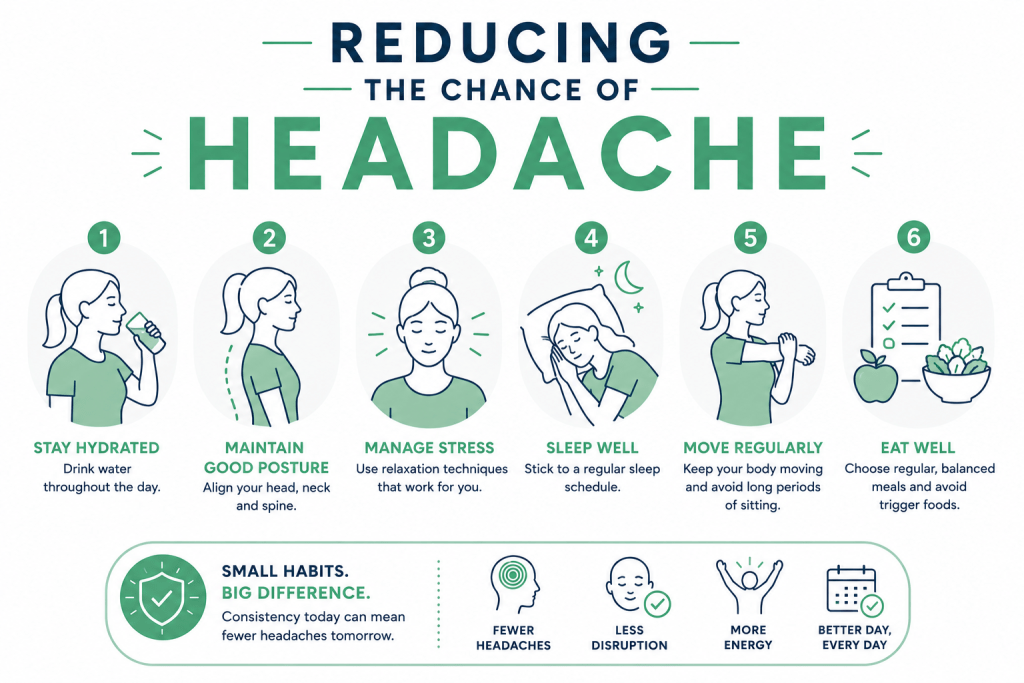
However, you can often improve your chances by identifying your triggers and building consistent habits around:
- regular movement
- exercise
- sleep
- hydration
- food and meal timing
- stress management
- neck and upper-back health
- appropriate treatment when required.
Most importantly, don’t try to change everything overnight.
Instead, identify the factors that appear most relevant to your headaches.
Then work on those consistently.
Why Is Understanding My Headaches So Important?
Not every headache is the same.
That’s one of the most important things to understand.
A headache can have many possible causes and patterns.
For example, headaches may be associated with:
- migraine
- tension-type headaches
- neck-related musculoskeletal problems
- medication overuse
- sleep problems
- dehydration
- illness
- other medical conditions.
Therefore, before thinking about prevention, it helps to understand what type of headache you’re experiencing.
That doesn’t mean you need to diagnose yourself.
Instead, it means becoming curious about your symptoms.
What Triggers My Headaches?
One of the most useful things you can do is identify patterns.
Consider keeping a simple headache diary for a few weeks.
Record:
- when your headache begins
- how long it lasts
- where you feel it
- what you were doing beforehand
- how well you slept
- what you ate and drank
- how much exercise you had
- your stress levels
- what made the headache better or worse.
You don’t need to create a complicated spreadsheet.
A few simple notes on your phone can be enough.
Over time, patterns may become easier to see.
Does Regular Exercise Help Headache Prevention?
For many people, regular physical activity can form an important part of headache prevention.
We’ve already discussed this in our article:
What Are the Best Exercises for Headache Relief?
The goal isn’t to exercise whenever you have a headache.
Instead, the aim is to develop a body that is better conditioned and accustomed to regular movement.
Good starting options include:
- walking
- cycling
- swimming
- resistance training
- mobility exercises
- general aerobic exercise.
Start at a level you can comfortably maintain.
Then gradually increase the amount as your fitness improves.
Consistency matters more than occasional intense workouts.
Is Walking a Part of Headache Prevention?
Walking deserves special attention because it’s so easy to underestimate.
You don’t need expensive equipment.
You don’t need a gym membership.
You don’t need to be extremely fit.
You simply need to walk.
A daily walk can help you:
- break up long periods of sitting
- maintain physical conditioning
- move your neck and upper body
- manage stress
- establish a consistent exercise routine.
Start with 10–20 minutes if necessary.
Then build gradually.
As we’ve discussed throughout this series:
Small daily improvements matter.
Can Poor Sleep Cause More Headaches?
Sleep and headaches can have a complicated relationship.
Poor sleep is not a contributor to headache prevention.
At the same time, headaches can interfere with sleep.
That creates an uncomfortable cycle.
You sleep poorly.
You wake feeling tired.
Your headache appears.
You become less active.
Then you sleep poorly again.
Fortunately, improving your sleep routine may help break that cycle.
Try to:
- maintain regular sleep and wake times
- create a relaxing evening routine
- reduce stimulating activities before bed
- keep your bedroom comfortable and dark
- give yourself enough time to sleep.
You don’t need a perfect sleep routine.
However, consistency helps.
Can Dehydration Trigger Headaches?
For some people, inadequate fluid intake can contribute to headaches.
This is particularly relevant if you’re exercising, working outdoors or spending time in hot weather.
Australia’s climate makes this worth considering, especially during summer.
Rather than waiting until you’re extremely thirsty, make hydration part of your daily routine.
Keep water available.
Drink regularly.
And remember that your fluid requirements can change with exercise, temperature and other factors.
If you have a medical condition that affects fluid intake, follow your healthcare professional’s advice.
Can Skipping Meals Cause Headaches?
For some people, long gaps between meals may contribute to headaches.
If you regularly skip breakfast, delay lunch or go for many hours without eating, pay attention to whether headaches tend to follow.
A simple approach is to establish reasonably consistent meal times.
Choose nutritious foods that provide:
- protein
- fibre
- healthy fats
- carbohydrates
- essential vitamins and minerals.
Again, the goal isn’t perfection.
It’s consistency.
If you notice a clear relationship between particular foods and your headaches, discuss it with an appropriate healthcare professional rather than unnecessarily eliminating large groups of foods.
Can Stress Make My Headaches Worse?
Stress is one of the most commonly reported headache triggers.
That doesn’t mean your headache is “all in your head.”
Stress produces genuine physical responses.
You may notice:
- increased muscle tension
- shallow breathing
- reduced movement
- poorer sleep
- changes in eating habits.
Over time, these changes may influence how you feel.
Therefore, managing stress isn’t simply about “relaxing.”
It’s about giving your nervous system regular opportunities to recover.
Walking, exercise, breathing exercises, hobbies, social connection and adequate sleep can all help.
Find strategies that genuinely work for you.
Can My Neck Contribute to Headache Prevention?
Yes, in some people.
This is particularly relevant if you experience:
- neck stiffness
- reduced neck movement
- headaches associated with neck pain
- symptoms that change with neck movement
- headaches after prolonged computer work.
We’ve explored this in detail in:
Are My Headaches Coming From My Neck?
When the neck contributes to headaches, treatment may involve a combination of:
- improving mobility
- strengthening
- exercise
- manual therapy
- changing aggravating activities
- improving movement habits.
However, not every headache comes from the neck.
That’s why assessment matters in headache prevention.
Can My Posture Cause Recurring Headaches? Posture can be part of the picture.
However, I’d encourage you not to become obsessed with sitting perfectly.
There is no single posture that you need to maintain all day.
Instead, think about movement variety.
If you’ve been sitting at a computer for two hours, even a theoretically “perfect” posture becomes less useful when you never change position.
Stand.
Walk.
Stretch.
Change your position.
Then return to work.
As we discussed earlier:
Movement may be more important than perfect posture.
What Daily Habits Can Help Prevent Headaches?
The good news is that many of the strategies we’ve discussed throughout this series overlap.
A simple daily routine could include:
Morning
- Drink some water.
- Move gently.
- Get outside if possible.
- Walk or exercise.
During the day
- Change position regularly.
- Take movement breaks.
- Eat regular meals.
- Drink water.
- Manage prolonged screen time.
Evening
- Reduce stimulating activities.
- Perform gentle mobility if helpful.
- Prepare for consistent sleep.
- Give yourself time to unwind.
You don’t need to follow this perfectly.
Instead, use it as a framework.
Greg’s Clinical Tip
Don’t try to find every possible headache trigger. Start by finding your most obvious one.
If you discover that your headaches repeatedly appear after poor sleep, start there.
If prolonged sitting is clearly associated with your symptoms, address your movement habits.
If exercise consistently helps, make it part of your routine.
Small changes are much easier to maintain than complete lifestyle overhauls.
What If I Still Get Headaches Despite Doing Everything Right?
This is an important question.
You can have excellent habits and still experience headaches.
That’s because headaches have many possible causes.
Therefore, don’t blame yourself when a headache occurs.
Instead, ask:
“What can I learn from this episode?”
Look for patterns.
Review what happened during the previous 24 hours.
Then consider whether anything was different.
However, if your headaches are becoming more frequent, severe or difficult to manage, don’t simply keep experimenting on your own.
Seek appropriate professional advice.
When Should I See a Chiropractor About Recurring Headaches?
A chiropractic assessment may be appropriate when your headaches appear to have a musculoskeletal component, particularly when they’re associated with neck pain, stiffness or movement problems.
An assessment can look at:
- neck movement
- joint function
- muscular tension
- posture and movement
- strength
- daily activities
- headache patterns.
The aim isn’t to assume your neck is responsible.
Instead, the aim is to determine whether your musculoskeletal system may be contributing.
If your symptoms suggest another cause, appropriate referral should take priority.
When Should I See My GP About Headaches?
Some headaches require medical assessment rather than chiropractic treatment.
Seek urgent medical attention if you experience a headache that is:
- sudden and extremely severe
- unlike your usual headaches
- associated with weakness or numbness
- associated with confusion or difficulty speaking
- accompanied by loss of consciousness
- associated with significant vision changes
- accompanied by fever and a stiff neck
- occurring after a significant head injury.
Likewise, arrange medical assessment if your headaches are changing significantly or becoming progressively worse.
It’s always better to investigate unusual symptoms than assume they’re simply another headache.
Can I Really Prevent My Headaches?
Sometimes.
But I’d encourage you to think about reducing frequency and improving control, rather than expecting perfection.
Your goal might be:
- fewer headache days
- less severe symptoms
- shorter episodes
- better recovery
- greater confidence
- less disruption to your life.
That can represent a significant improvement.
And importantly, it gives you something meaningful to work towards.
What Is the Simplest Headache Prevention Plan?
If everything we’ve discussed feels overwhelming, start here.
1. Move every day.
Walk for 20–30 minutes.
2. Break up sitting.
Move every 30–45 minutes.
3. Sleep consistently.
Aim for a regular sleep routine.
4. Stay hydrated.
Drink water regularly throughout your day.
5. Eat regularly.
Avoid routinely going long periods without food.
6. Strengthen your body.
Build general strength and physical capacity.
7. Track your headaches.
Look for patterns rather than guessing.
8. Get assessed when necessary.
Don’t ignore recurring or changing symptoms.
That’s your starting framework.
You can build from there.
What Have We Learned From the Headache Series?
We’ve now covered a lot of ground.
Week 1 — Chiropractic and Your Headaches
We started by looking at headaches more broadly and explaining how chiropractic care may fit into headache management.
Week 2 — Are My Headaches Coming From My Neck?
We explored the relationship between the neck and certain headaches.
Week 3a — Can Poor Posture Cause Headaches?
We challenged the idea that one “bad” posture automatically causes headaches.
Week 3b — Is Movement More Important Than Perfect Posture?
We shifted the focus from maintaining perfect posture towards regular movement.
Week 3c — Healthy Daily Habits for Headaches
We explored five simple habits that support better health.
Week 4 — Why Do I Wake Up With a Headache?
We looked at why morning headaches may occur and what your symptoms could be telling you.
Week 5 — What Are the Best Exercises for Headache Relief?
We looked at practical exercises and how to build physical capacity safely.
And now we’re bringing everything together.
What Is the Biggest Lesson From This Series?
There is rarely one single answer to recurring headaches.
Instead, improvement often comes from understanding the whole picture.
Your sleep matters.
Your movement matters.
Your exercise matters.
Your stress matters.
Your neck may matter.
Your daily habits matter.
And, importantly, the type of headache you’re experiencing matters.
Rather than searching for a miracle cure, build a better understanding of your body.
Then make sensible changes.
Over time, those small changes can make a meaningful difference.
Frequently Asked Questions
Can I completely prevent headaches?
Not necessarily. Some headaches have triggers you can identify and manage, while others may occur despite healthy habits. However, understanding your headache pattern, improving sleep, exercising regularly and managing known triggers can help some people reduce headache frequency and severity.
How can I find out what triggers my headaches?
A simple headache diary can help. Record when headaches occur, your sleep, meals, exercise, hydration, stress and activities beforehand. After several weeks, patterns may become easier to identify. If your headaches change or become frequent, discuss your symptoms with an appropriate healthcare professional.
Should I exercise if I regularly get headaches?
Regular exercise may help some people manage recurring headaches. Walking, aerobic exercise, mobility and strengthening can all be useful. However, if exercise consistently triggers or worsens your headaches, stop and seek appropriate assessment rather than repeatedly pushing through symptoms.
Can chiropractic care help prevent recurring headaches?
Chiropractic care may help some people when their headaches have a musculoskeletal component, particularly when neck pain or stiffness is present. Assessment may include neck movement, muscular function and daily habits. However, not every headache is caused by the neck, so appropriate diagnosis and referral remain important.
When should recurring headaches be medically assessed?
You should seek medical advice when headaches become more frequent, severe or different from your usual pattern. Sudden severe headaches, neurological symptoms, significant vision changes, confusion, fever with neck stiffness or headaches following significant head injury require prompt medical assessment.
What Should I Do If My Headaches Keep Coming Back?
Don’t simply keep treating each headache as an isolated event.
Instead, step back.
Look for patterns.
Ask better questions.
Then identify the changes that are most likely to help you.
If your headaches are recurring or affecting the things you enjoy, book a comprehensive headache assessment at Northcote Chiropractic Centre.
We’ll start by understanding your symptoms, your history and the factors that may be contributing.
One Final Thought…
Over the past six weeks, we’ve looked at headaches from many different angles.
And perhaps the biggest lesson is this:
Your headache is not your identity.
It’s a symptom.
Something your body is communicating.
Sometimes the answer is simple.
Sometimes it requires more investigation.
And sometimes several small factors combine to create the problem.
That’s why I don’t want you to become obsessed with finding one perfect posture, one perfect pillow or one perfect exercise.
Instead:
Understand it.
Move better.
Stay consistent.
Trust your body again.
That’s the approach we’ve taken throughout this series.
And it’s the approach I use every day with patients at Northcote Chiropractic Centre.
Your ultimate goal isn’t simply to have fewer headaches.
It’s to wake up feeling confident.
To exercise without fear.
To work without constantly thinking about your neck.
To play with your grandchildren.
To travel.
To enjoy your life.
In other words, to have the freedom to do what you want without pain.
That’s what we’re really working towards.
– Dr Greg Conlan