
13 Jul Neck Headaches: Is Your Neck Causing Your Headaches?
Neck Headaches: Is Your Neck Causing Your Headaches?
Yes, your neck can be the source of your headaches. These are known as cervicogenic headaches or, more simply, neck headaches. They occur when joints, muscles or nerves in the upper neck send pain signals to the brain, which interprets them as pain in the head. Identifying whether your headache is actually coming from your neck is the first step towards choosing the right treatment.
One of the comments we hear most often is: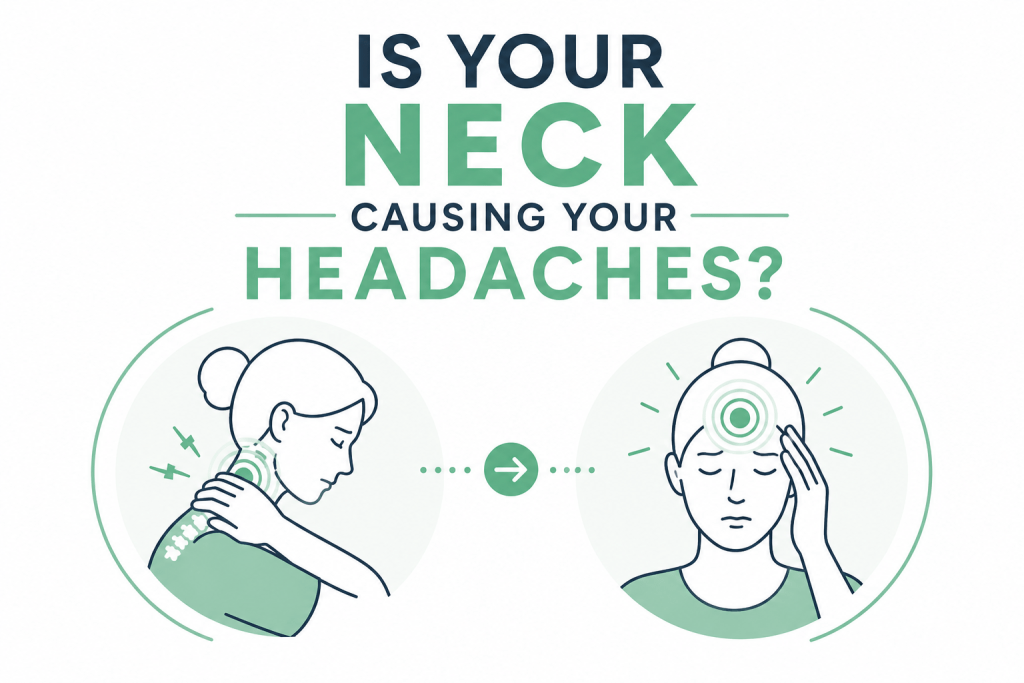
“My headache is in my forehead…how can it possibly be coming from my neck?”
It’s a great question.
The answer lies in the way your nervous system is wired.
The upper part of your neck shares nerve pathways with areas of your head. When those joints or muscles become irritated, your brain can sometimes interpret those signals as head pain instead of neck pain.
That’s why some people experience regular headaches even though they hardly notice any neck pain at all.
If you haven’t already read our cornerstone guide, I recommend starting with Chiropractic for Headaches: Causes, Types & Treatment, where we explain the different headache types and how chiropractors assess them.
What exactly are neck headaches?
A neck headache, or cervicogenic headache, is a headache that originates from structures in the cervical spine.
Rather than beginning in the head itself, the pain starts in the neck before being referred into the head.
The structures most commonly involved include:
- Upper neck joints
- Neck muscles
- Ligaments
- Cervical discs
- Nerves surrounding the upper cervical spine
Although the pain is felt in your head, the source of the problem is elsewhere.
Think of it like pain travelling down your leg from your lower back.
The pain is real—but the source is somewhere different.
Exactly the same principle applies to many neck headaches.
Greg’s Clinical Tip
Over the past 35 years, one of the most common surprises for patients is discovering that their “head problem” is actually a neck problem. Once we explain how the nerves of the upper neck communicate with the brain, it suddenly makes sense why treating the neck—not just the head—can make such a difference for the right patient.
How do I know if my headache is coming from my neck?
No single symptom proves that your headache is coming from your neck.
Instead, chiropractors look for a pattern of signs.
You may recognise several of these.
Your headache begins in your neck
Many people notice discomfort starting around:
- the base of the skull
- the upper neck
- behind one ear
The pain then gradually moves forwards towards:
- the temple
- the forehead
- behind the eye
This pattern is very typical of cervicogenic headaches.
Turning your head makes the headache worse
This is one of the biggest clues.
If rotating your head while reversing the car, looking over your shoulder or checking your blind spot reproduces your headache, the neck may be involved.
Likewise, looking upwards for prolonged periods—such as painting a ceiling or pruning trees—may also aggravate symptoms.
You also have neck stiffness
Many patients tell us:
“My neck has always been stiff, but I never connected it with my headaches.”
Restricted neck movement often accompanies cervicogenic headaches.
Sometimes the stiffness appears before the headache.
Sometimes it develops afterwards.
Your headache is usually on one side
Unlike tension headaches, which commonly affect both sides of the head, cervicogenic headaches frequently remain on the same side.
The pain may spread, but it often has a consistent starting point.
Poor posture makes your headache worse
Do your headaches develop after:
- working at the computer?
- driving for several hours?
- gardening?
- reading in bed or watching TV?
- scrolling on your phone?
If so, your neck may be under prolonged mechanical stress.
Why can a neck problem cause pain in my head?
This is one of the most fascinating parts of headache science.
The top three joints of your neck (Occiput – C1, C1-C2 and C2-C3) share nerve connections with the sensory nerves supplying your head and face. These are the nerves that let the brain know what is happening to the head and face. For example a sensory nerve will tell your brain that a fly landed on your face or a hair is brushing your eye.
Underneath the brain is the brainstem. It performs many functions including essential survival mechanisms such as controlling heart rate and breathing as well as a relay portal for all the sensory and motor information passing between the brain and body.
Inside the brainstem, the nerve signals of both the upper cervical joints and the sensory nerves of the head and face meet in an area called the trigeminocervical nucleus. This is called convergence.
Fortunately, you don’t need to remember any of these big words.
The important point is this:
Your brain sometimes struggles to identify exactly where these pain signals are coming from.
Instead of recognising a problem as neck pain, it interprets it as head pain.
This process is known as referred pain.
It’s the same reason people having a heart attack sometimes feel pain in their left arm rather than directly over their heart.
Pain isn’t always felt where it begins.
Did You Know?
Research suggests that cervicogenic headaches account for around 15 to 20% of all headaches in the general population, but they are seen much more frequently in people with persistent neck pain following injury, whiplash or prolonged postural strain. In fact, it is reported that up to 53% of people after whiplash suffer from cervicogenic headache.
What causes neck headaches to develop?
Usually, there isn’t just one cause.
Instead, several contributing factors gradually build up over months or years.
Common contributors include:
Poor posture
Modern life encourages us to spend hours with our heads positioned forwards.
Every centimetre your head moves in front of your shoulders increases the load on your neck muscles.
Over time, those muscles fatigue, joints stiffen and irritation develops.
Prolonged computer use
Many office workers remain in one position for hours without realising it.
Even with an excellent workstation, your body still needs movement.
That’s why we encourage patients to change position every 30–45 minutes.
Movement is often more important than perfect posture.
Previous whiplash injuries
Even years after a motor vehicle accident, some people continue to experience headaches.
Old injuries may leave certain joints less mobile and muscles more sensitive.
Fortunately, many patients still improve with an appropriate rehabilitation programme.
Arthritis
Age-related changes in the joints of the neck can sometimes contribute to headaches.
However, arthritis doesn’t automatically mean you’ll develop headaches.
Many people with arthritic changes have no pain at all.
It’s often the combination of joint stiffness, muscle tension and reduced movement that becomes important.
Stress
Stress rarely acts alone.
Instead, it increases muscle tension, encourages jaw clenching, alters posture and reduces sleep quality.
All of these factors may contribute to neck headaches.
Myth vs Fact
MYTH: Every headache is a migraine.
FACT: Most headaches seen in clinical practice are not migraines. Many are tension-type headaches or cervicogenic headaches, each requiring a different management approach.
How are neck headaches different from a migraine?
Patients often ask this question because the symptoms can overlap.
While both can be very painful, they usually have different causes and require different management.
Here’s a simple comparison.
| Neck Headache (Cervicogenic) | Migraine |
| Usually starts in the neck | Often starts without neck pain |
| Often one-sided | Usually one-sided but can switch sides |
| Worse with neck movement | More affected by light, sound or certain triggers |
| Neck stiffness is common | Nausea and vomiting are more common |
| May improve as neck movement improves | Often requires broader medical management |
It’s important to remember that some people experience both migraines and neck-related headaches.
For example, someone with migraines may also have stiff upper neck joints that make their migraine attacks more frequent or more severe.
That’s why a detailed examination is so important.
How are neck headaches different from a tension headache?
This can be even harder to distinguish.
Tension headaches usually produce:
- pressure across both sides of the head
- a tight band feeling
- muscle tightness around the scalp
- aching behind the eyes
- mild to moderate pain
A neck headache is more likely to:
- begin at the base of the skull
- remain on one side
- worsen with neck movement
- reproduce pain when certain neck joints are examined
- improve as neck function improves
Sometimes the two occur together.
A stiff neck can contribute to muscle tension, making the distinction less obvious.
Greg’s Clinical Tip
One thing I’ve learnt over the years is not to rush to label a headache. Patients often arrive convinced they have migraines because the headaches are severe. After a careful history and examination, we sometimes find the upper neck is the primary contributor. Equally, I’ve seen patients who believed they had a “neck problem” when they actually needed medical management for migraines. A good diagnosis always comes before good treatment.
How do chiropractors diagnose neck headaches?
There isn’t a blood test or scan that confirms a cervicogenic headache.
Instead, diagnosis comes from putting together several pieces of information.
Think of it as solving a puzzle.
Each clue adds to the overall picture.
We begin by listening
Your history often provides the biggest clues.
We’ll ask questions like:
- Where does the pain begin?
- Does the headache spread?
- What activities trigger it?
- How often does it occur?
- Have you had previous neck injuries?
- Do you wake with headaches?
- Does moving your neck reproduce the pain?
The answers help narrow the possibilities before we even begin the physical examination.
We assess how your neck moves
Healthy neck joints should move freely and comfortably.
During the examination we’ll assess:
- neck rotation
- side bending
- flexion
- extension
We’re looking for movements that are:
- restricted
- painful
- asymmetrical
- capable of reproducing your familiar headache
That last point is especially important.
If a particular neck movement reproduces your usual headache, it provides a valuable diagnostic clue.
We examine the muscles
The muscles around the neck and shoulders often become overworked.
We’ll assess for:
- tightness
- weakness
- trigger points
- tenderness
- muscle imbalance
It’s common to find several muscles contributing rather than just one.
We assess your posture
Posture doesn’t cause every headache.
However, poor postural endurance often contributes to ongoing neck irritation.
We’ll look at:
- head position
- shoulder posture
- upper back alignment
- workstation habits
- movement patterns
This helps us identify habits that may be repeatedly loading the neck.
We perform neurological testing
Patient safety always comes first.
Neurological examination helps ensure there isn’t evidence of:
- nerve injury
- spinal cord involvement
- significant neurological disease
If your history or examination raises concerns, we’ll arrange referral for appropriate medical investigation.
Will I need an X-ray or MRI for my neck headaches?
Most neck headaches can be diagnosed from a careful history and physical examination.
Imaging is generally reserved for situations where:
- significant trauma has occurred
- serious pathology is suspected
- symptoms aren’t responding as expected
- neurological findings require further investigation
Many people are surprised to learn that scans often show age-related changes even in people with no pain.
That’s why your symptoms and examination findings are usually far more important than the scan itself.
Did You Know?
Research has shown that many adults have disc bulges and arthritic changes on MRI without any neck pain or headaches. Imaging findings don’t always explain your symptoms, which is why clinical examination remains so important.
What does chiropractic treatment for neck headaches involve?
Treatment begins only after we’ve identified the most likely cause of your headache.
Depending on your findings, your care may include:
Gentle chiropractic adjustments
These aim to improve movement in stiff joints and reduce irritation within the upper cervical spine.
Treatment is always adapted to the individual.
Soft tissue therapy
Tight muscles often contribute to neck headaches.
Techniques may include:
- trigger point therapy
- massage
- stretching
- myofascial release
Reducing muscle tension can improve comfort and make movement easier.
Mobility exercises
Restoring movement is one thing.
Keeping it is another.
We’ll often prescribe simple exercises to maintain the improvements achieved during treatment.
Strengthening exercises
Long-term success usually depends on improving the endurance of the muscles supporting your neck and upper back.
This becomes particularly important for people who spend long hours at a desk.
Postural coaching
Rather than telling patients to “sit up straight” all day—which is unrealistic—we focus on building better movement habits.
Remember:
The best posture is your next posture.
Changing position regularly is often more valuable than trying to maintain one “perfect” posture.
A patient story
One patient in her early 50s came to see us after several years of recurring headaches.
She had tried changing pillows, massage and regular pain medication with only temporary relief.
During her assessment we found that rotating her upper neck reproduced her familiar headache almost immediately.
Her treatment focused on improving joint mobility, reducing muscle tension and teaching simple daily exercises.
Over the following weeks, her headaches became less frequent and she regained confidence to return to gardening—one of the activities she had gradually stopped because it consistently triggered her symptoms.
Every patient is different, but this illustrates why identifying the source of the headache is often more important than simply treating the pain.
How long does it take for neck headaches to improve?
This is one of the first questions patients ask after we’ve identified that their headaches are likely coming from the neck.
The honest answer is that recovery depends on several factors, including:
- How long you’ve had the headaches.
- Whether you’ve had previous neck injuries.
- Your daily work and posture.
- Your general health and fitness.
- How consistently you follow your home programme.
Some patients notice meaningful improvement within the first few treatments.
Others, particularly those with long-standing symptoms or previous whiplash injuries, may require a longer rehabilitation programme.
Our aim isn’t simply to reduce your headache today.
It’s to improve the way your neck functions so that headaches become less frequent and less likely to return.
One of the strongest predictors of success is your involvement in the recovery process.
Patients who understand their condition and consistently follow their home exercises often achieve better long-term outcomes.
We’ll explore recovery timelines in much greater detail in our upcoming article:
➡ How Long Does It Take for Headaches to Improve With Chiropractic?
What can I do at home if my headaches are coming from my neck?
While treatment at the clinic plays an important role, what you do between appointments often has an even greater influence on your recovery.
Here are several practical strategies that many patients find helpful.
Keep your neck moving
Unless you’ve been advised otherwise, gentle movement is usually better than complete rest.
Simple neck mobility exercises performed several times throughout the day can reduce stiffness and improve circulation.
Avoid staying in one position
The neck prefers movement.
Whether you’re working at a computer, reading or driving, aim to change position every 30 to 45 minutes.
Even standing, stretching or walking for one minute can reduce the load on your neck.
Optimise your workstation
Check that:
- Your monitor is at eye level.
- Your chair supports your lower back.
- Your elbows rest comfortably by your side.
- Frequently used items are within easy reach.
Remember, even a perfect workstation cannot compensate for sitting still all day.
Manage stress
Stress doesn’t just affect your mood.
It often increases muscle tension around the neck, shoulders and jaw.
Regular exercise, controlled breathing, mindfulness and spending time outdoors can all help reduce this tension.
Build strength, not just flexibility
Many people spend years stretching tight muscles but never strengthen the muscles responsible for supporting their posture.
Long-term improvement usually requires both mobility and strength.
We’ll cover the best exercises in our upcoming article:
➡ What Are the Best Exercises for Headache Relief?
Greg’s Clinical Tip
One of the biggest changes I’ve seen over the past 35 years is the effect of technology on the neck. Years ago, we treated more headaches related to physical work. Today, many headaches are linked to prolonged sitting, laptops, dual screens and mobile phones. The encouraging news is that small changes—better movement habits, improved posture and targeted exercises—often produce meaningful improvements over time.
The Simple Daily Checklist
Small actions performed consistently often produce the greatest long-term improvements.
Before tomorrow, try to:
✅ Get up and move every 30–45 minutes.
✅ Perform your neck mobility exercises twice today.
✅ Walk for at least 20 minutes.
✅ Keep your phone closer to eye level instead of bending your neck.
✅ Drink enough water throughout the day.
✅ Finish the day with five minutes of gentle stretching.
Remember…
The best posture is your next posture.
Small improvements become lifelong habits.
Myth vs Fact for neck headaches
MYTH: If I don’t have neck pain, my headaches can’t be coming from my neck.
FACT: Many people with cervicogenic headaches experience very little neck pain. The upper cervical joints can refer pain into the head because they share nerve pathways in the brainstem. That’s why a thorough examination is more reliable than judging symptoms alone.
Frequently Asked Questions
Can I have a neck headache without neck pain?
Yes. Many people are surprised to learn that headaches originating from the upper neck can occur with very little neck discomfort. This happens because pain is referred through shared nerve pathways. A detailed assessment helps determine whether your neck is contributing to your headaches.
Should I stretch my neck during a headache?
Gentle movement is often helpful for neck-related headaches, particularly if stiffness is present. However, forceful stretching can aggravate symptoms. It’s best to perform exercises that have been recommended for your specific condition and stop if they significantly increase your pain.
Can sleeping awkwardly trigger a neck headache?
Yes. Sleeping with your neck in an awkward position or using a pillow that doesn’t adequately support your neck can contribute to morning headaches in some people. We’ll discuss this in more detail in our next article, Why Do I Wake Up With a Headache?
Can chiropractic care prevent headaches from returning?
No treatment can guarantee headaches won’t return. However, improving neck function, maintaining strength, correcting contributing habits and staying active can reduce the likelihood of recurring cervicogenic headaches for many people.
When should I seek urgent medical care?
Seek immediate medical attention if you experience a sudden severe headache, headache following significant trauma, weakness, difficulty speaking, vision changes, seizures, confusion or fever with neck stiffness. These symptoms require urgent medical assessment rather than chiropractic treatment.
Continue Learning About Headaches
This article is part of our complete headache education series.
For a broader understanding of headache causes and treatment, read our cornerstone guide:
➡ Chiropractic for Headaches: Causes, Types & Treatment
You may also enjoy the next articles in this series:
- Can Poor Posture Cause Headaches?
- Why Do I Wake Up With a Headache?
- What Are the Best Exercises for Headache Relief?
- How Long Does It Take for Headaches to Improve With Chiropractic?
Together, these resources are designed to help you better understand, manage and prevent headaches.
Ready to find out whether your headaches are coming from your neck?
If you’ve been treating the symptoms without understanding the cause, it’s time to take the next step.
Book a comprehensive assessment at Northcote Chiropractic Centre.
We’ll determine whether your headaches are likely to be coming from your neck, explain your findings in plain English, and develop a personalised treatment plan to help you get back to living life with fewer headaches and greater confidence.